Overview
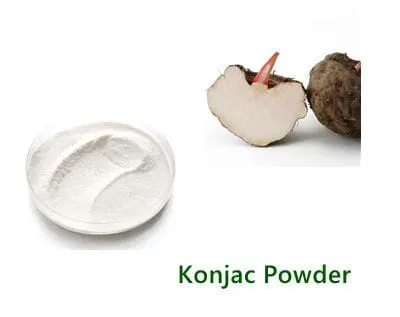
Konjac Powder is derived from the corms of Amorphophallus konjac and is rich in Konjac Glucomannan (KGM), a natural water-soluble dietary fiber. Our raw materials are sourced from konjac corms in China's Yunnan, Guizhou, Sichuan and Hubei provinces, grown in high-altitude areas.
We use low-temperature physical extraction and purification (free of chemical solvents and additives) to retain active content while removing impurities.
KGM content ranges from 80% to 95% (customizable), with a molecular weight of 200,000–2,000,000 Daltons and strong gel-forming, thickening and water-absorbing properties.
Differentiation advantages: high purity (KGM up to 95%, ash ≤3.0%), stable quality (viscosity 20,000–40,000 mPa·s, particle size 40–120 mesh), and versatile gel behavior (reversible / irreversible gels). It is listed as a common food in China.
Key Active Compounds
The core component is Konjac Glucomannan (KGM), a non-ionic water-soluble heteropolysaccharide of D-glucose and D-mannose (molar ratio ~1:1.4–1.6), with 5%–10% acetylation affecting its solubility and gel properties.
Minor naturally associated components include trace polysaccharides, amino acids, vitamins and minerals.
Functional Properties
KGM is valued primarily as a functional fiber and texturizing ingredient:
- Gel-forming — forms stable reversible / irreversible gels for konjac-based foods and plant-based alternatives.
- Thickening & stabilizing — improves viscosity and stability, reducing separation.
- Water-retaining & binding — improves texture and yield in meat, baked and pasta products.
- Film-forming — forms biodegradable edible films.
Researched Activities
The following reflect areas reported in published research on glucomannan dietary fiber and are provided for formulation context, not as product claims:
- Satiety research — glucomannan dietary fiber has been studied in research relating to satiety endpoints.
- Digestive / prebiotic research — studied for fermentation and intestinal-transit effects.
Application Areas
- Food industry — functional and health foods (5%–15%); gel foods such as konjac tofu, noodles and plant-based meat (8%–20%); baked goods and pasta (2%–5%); dairy and beverages (0.5%–3%); meat products (1%–4%).
- Pharmaceutical — excipient for sustained-release tablets and capsules.
- Cosmetics & personal care — moisturizer / thickener in masks, lotions and hair care (1%–5%).
- Other — animal feed (2%–5%) and biodegradable bio-based materials.
Why GreeneryBio
- High-altitude provincial sourcing with customizable KGM grades (80–95%).
- Solvent-free low-temperature processing.
- COA, TDS and MSDS issued per batch.