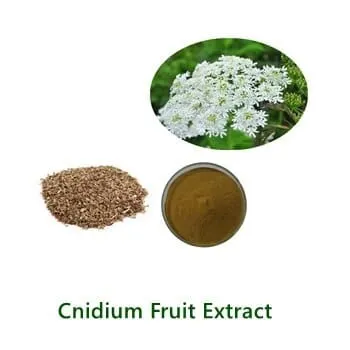
Overview
Cnidium Monnieri Extract is derived from the dried fruit of Cnidium monnieri (L.) Cuss., mainly from Chinese planting bases, and is produced to relevant cosmetic and food/pharmaceutical-grade standards. We use low-temperature solvent extraction, membrane separation and spray-drying to maximize bioactive content while removing impurities and residues.
The key marker component is Osthole (10%–98%, HPLC), accompanied by bergapten, xanthotoxin and isoimperatorin. Advantages: traceable raw materials, customizable specifications (10:1 ratio extract through 98% Osthole), and full quality testing.
Key Active Compounds
The extract's profile is based on coumarin derivatives:
- Osthole (CAS 484-12-8) — primary marker compound and basis of standardization.
- Bergapten — associated coumarin constituent.
- Xanthotoxin — associated coumarin constituent.
- Isoimperatorin — associated coumarin constituent.
Researched Activities
The following reflect areas reported in published research and are provided for formulation context, not as product claims:
- Antimicrobial research — osthole and related coumarins have been studied in antibacterial and antifungal assays.
- Signaling-pathway research — osthole has been studied for modulation of NF-κB and related signaling in cell and animal models.
- Other research interest — investigated in models relating to bone-metabolism and neuronal activity.
Application Areas
- Cosmetics & personal care — topical formulations for sensitive-skin and skin-comfort positioning.
- Dietary supplements — capsules and tablets.
- Research & analytical — osthole reference material.
Why GreeneryBio
- Traceable raw materials with customizable osthole specifications (10:1 to 98%).
- Low-temperature processing for controlled residues.
- COA, TDS and MSDS issued per batch.